FlowCart

Robot Housekeeper Cart: Empowering Housekeeping Work through Etiquette-Based Interactions in Hotels

Introduction

Housekeeper carts are essential in hotel operations but often create friction for both workers and guests. Our observational study revealed that conventional carts are heavy, difficult to maneuver, and prone to causing strain on housekeeping staff. They also occupy highly visible public spaces, becoming part of the guest experience.

This project reimagines carts not just as functional tools, but as interactive agents capable of participating in the social texture of hotels. We designed a modular cart and robot laundry module that uses non-verbal etiquette behaviors—like proactive greetings and anticipating needs—to communicate politely with bystanders.

Keywords: Human-Robot-Interaction, Hotel Robot, Non-verbal Interactions, Physical Prototyping
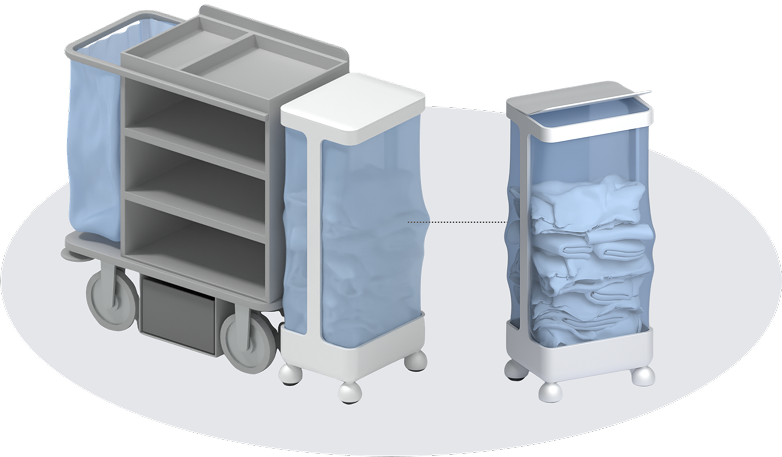
FlowCart Concept Image

Overview

Context

Published in HRI Companion '26

Time Frame

Mar 2025 — Mar 2026 (1 Year)

Project Type

Academic Research

Platform / Tech

Physical Computing, Robotics, ODrive, Raspberry Pi

Market Analysis

Operational Pressure & Customer Discovery

During our customer discovery at the Statler Hotel, we found that labor represents approximately 35-40% of operating costs, making it the hotel’s largest expense (about $44 per occupied room). Staffing shortages are common, and the physical toll of housekeeping leads to frequent shoulder and back injuries. The hospitality industry needs a solution that maintains productivity with fewer staff and reduces repetitive physical strain.

Market Analysis

Business Model

Robot-as-a-Service (RaaS)

Nomu FlowCart operates under a Robot-as-a-Service (RaaS) model with a $2,000 upfront setup fee and a $350 monthly subscription per robot. This allows hotels to adopt the system with minimal upfront investment while generating recurring revenue for Nomu.

Business Model

Research & Observational Study

The Hidden Strain in Housekeeping

Through shadowing housekeepers, we discovered that conventional carts are bulky and incredibly heavy. Staff often have to back up and lean their entire body weight on the carts just to push them forward. These heavy carts also frequently damage hotel walls in narrow hallways. Based on these observations, we envisioned a modular cart system where components like a laundry module can operate independently, reducing the physical strain on workers.

FlowCart Observational Insight

Interaction Design

Etiquette-Based Non-verbal Behaviors

Hotels are sensitive environments where unwanted sounds and lights are discouraged. Therefore, we grounded the robot's interactions in non-verbal etiquette designed around the physical movement of the laundry module and its lid:

FlowCart Etiquette Interactions

Prototyping & Field Testing

Building a Functional Laundry Robot

We built our functional prototype using the WOWLIVE 100L Rolling Laundry Hamper. By adopting a hoverboard-ODrive conversion methodology, we repurposed hoverboard motors with an ODrive controller and a Raspberry Pi. We then conducted a multi-phase Wizard of Oz (WoZ) study both in a controlled studio environment and in natural public corridors.

FlowCart Prototype Output

Publications & Recognition

Robot Housekeeper Cart: Empowering Housekeeping Work through Etiquette-Based Interactions in Hotels

Nanyi Jiang, Borui Wang, and Xiaozhen Liu.

doi:10.1145/3776734.3794607

HRI Companion '26: Companion Proceedings of the 21st ACM/IEEE International Conference on Human-Robot Interaction